

Turn local expertise into clear priorities for regional growth.
10 questions · 5 minutes · No account required to start
Recent coverage
Press & Media Highlights
Partner: Lethbridge County, Alberta. Coverage: Global News and CTV News.
Global News
Lethbridge County partners with The Groundbreakers
CTV News
Lethbridge County tests the Ecosystem Navigator
What the platform shows you
Regional economic intelligence you can't get any other way
Every diagnostic is a research-backed analysis of your place. Combine diagnostics from different roles and places, and the platform shows where the responses match, where they differ, and how they change over time.
The weakest stage of your innovation cycle
The stage respondents rate lowest, and whether respondents in other places rate the same stage low.
See an exampleDifferences between roles and places
Ratings compared question by question, so differences between groups are shown instead of hidden in one average.
See an exampleRecurring recommended actions
Recommended actions that appear in more than one report, with a count of how many reports include each one.
See an exampleChange over time
Repeat the same exercise, compare the results with the earlier round, and share the comparison with councils, boards, and partners.
See an exampleHow it works
Diagnose
Run a locally tailored diagnostic. The free version uses 10 questions; the complete workspace uses 15 for a richer baseline.
Compare
Invite people across roles or places, then see where their responses match and where they differ.
Decide and measure
Investigate the evidence, share clear priorities, and repeat the same exercise to make change visible over time.
The platform does not replace the final strategy, business interviews, or facilitator. It provides the starting evidence for that work, based on your region.
Get the complete workspace, USD $499/yearSample diagnostics
Sample findings by place
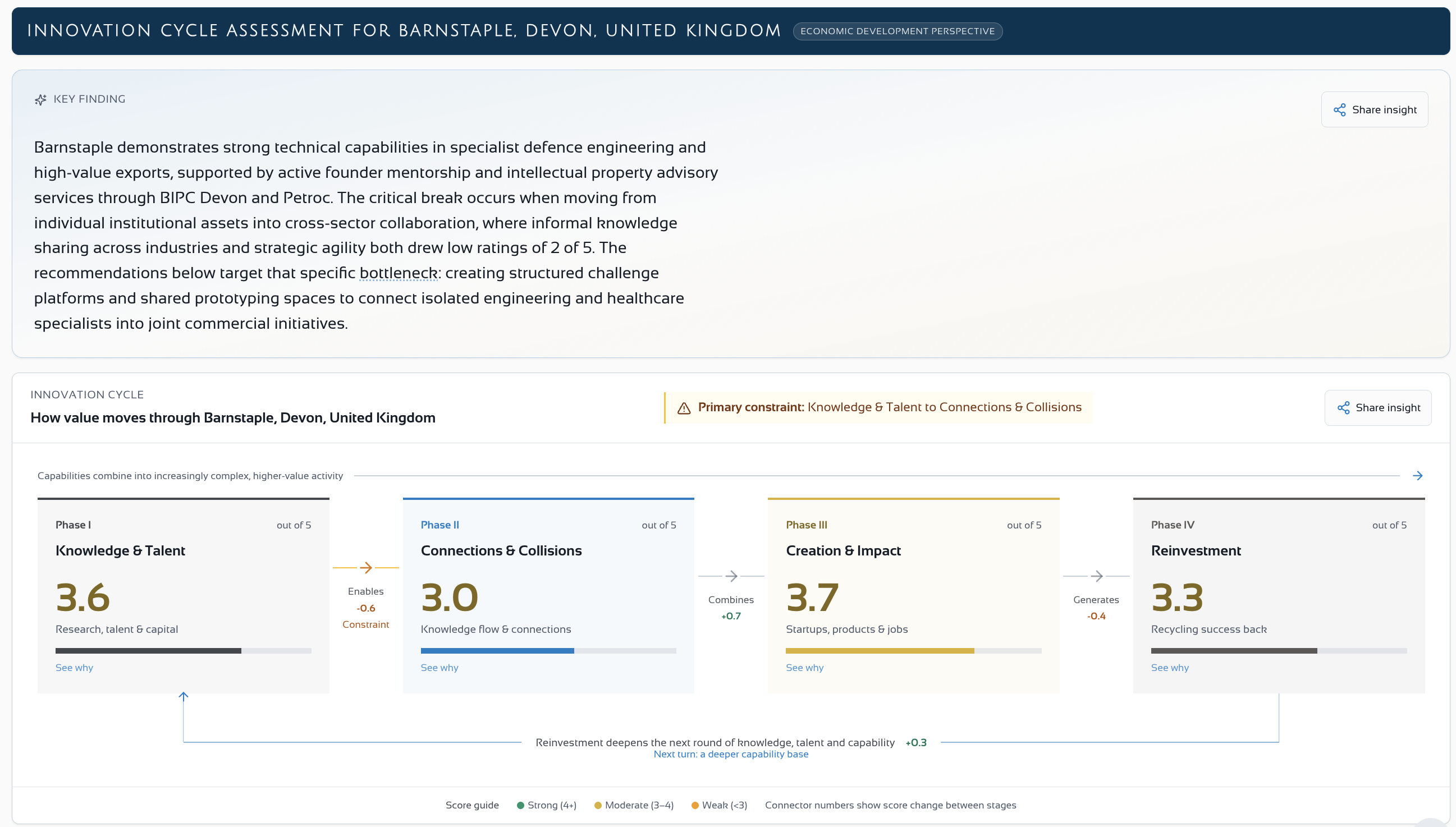
Barnstaple, Devon, United Kingdom
Strong defence engineering and founder support. The weakest transition is from Knowledge & Talent to Connections & Collisions.
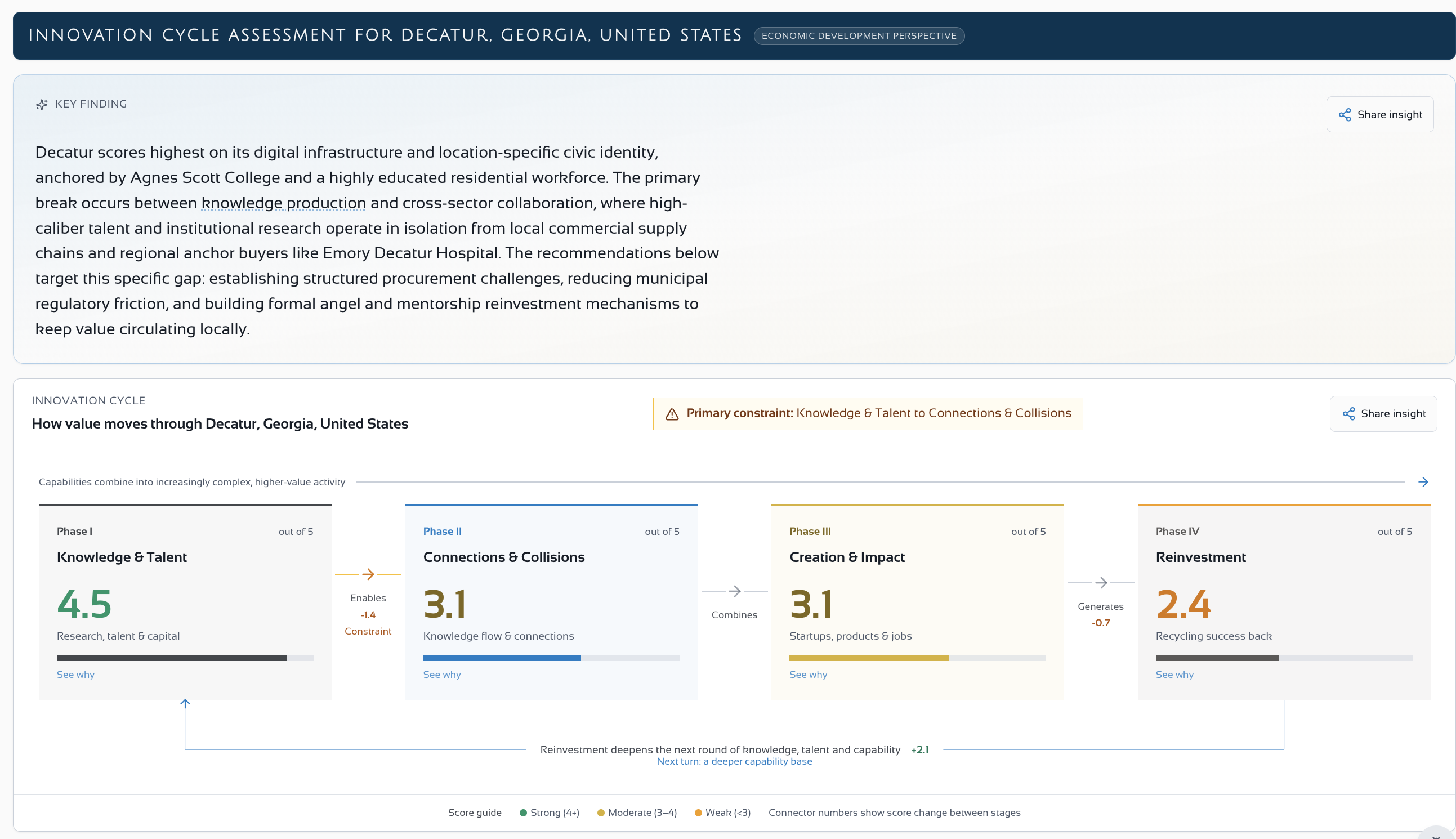
Decatur, Georgia, United States
The diagnostic identifies the lowest-rated stage of the innovation cycle and explains the likely reasons.
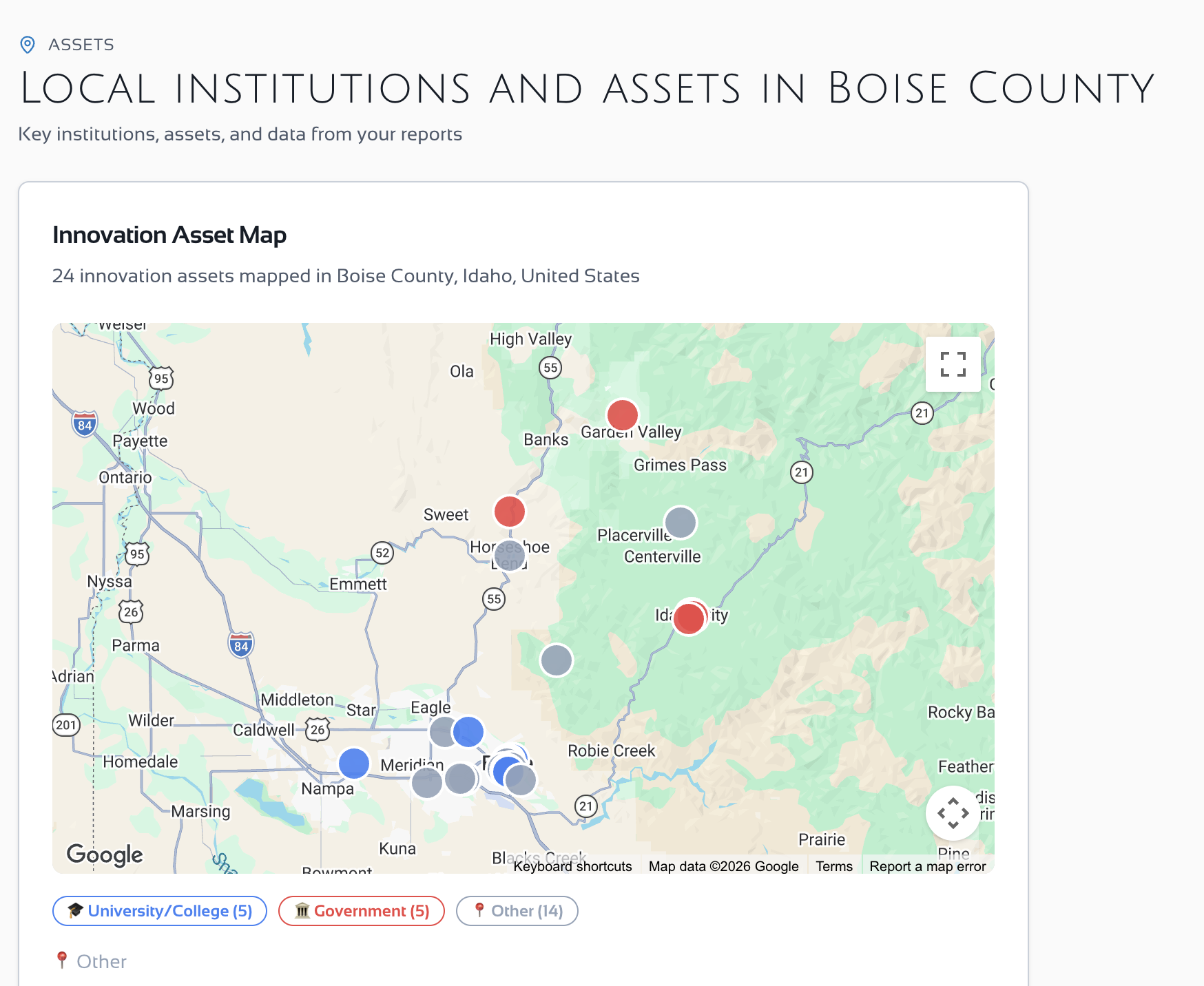
Boise County, Idaho, United States
24 local institutions and assets mapped from the diagnostic.
Sample reports only. The diagnostic is based on structured expert elicitation: a real report uses ratings from the people who know your region's economy best.
Group diagnostics in the complete workspace
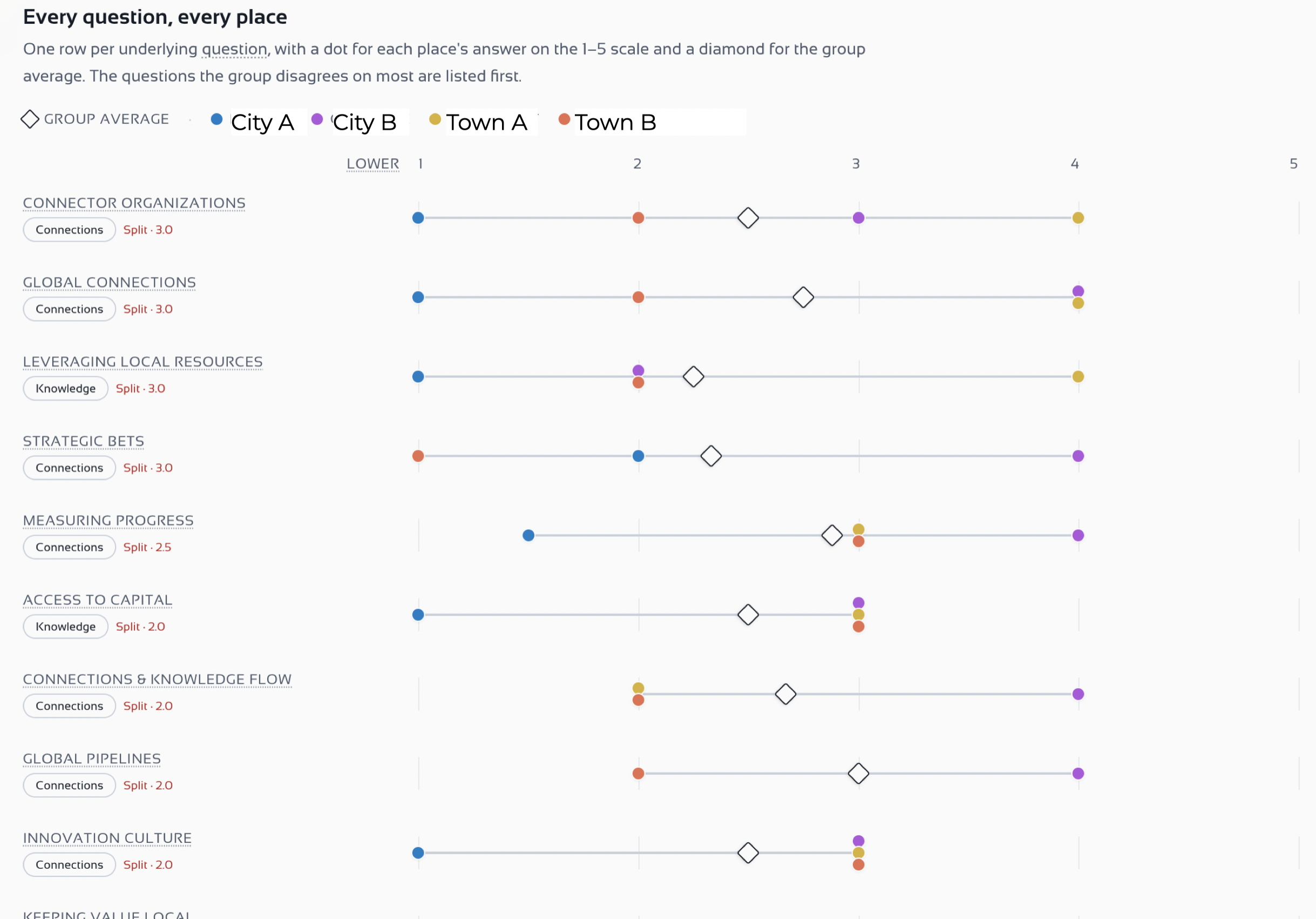
Compare how different people rate the same ecosystem
Invite a group, collect every response, and see question by question where the ratings match and where they differ. Differences are shown instead of hidden in one average.
Where each place rates higher or lower than the group
Who rates the ecosystem more favourably, who sees more constraints, and on which questions the gap is largest.
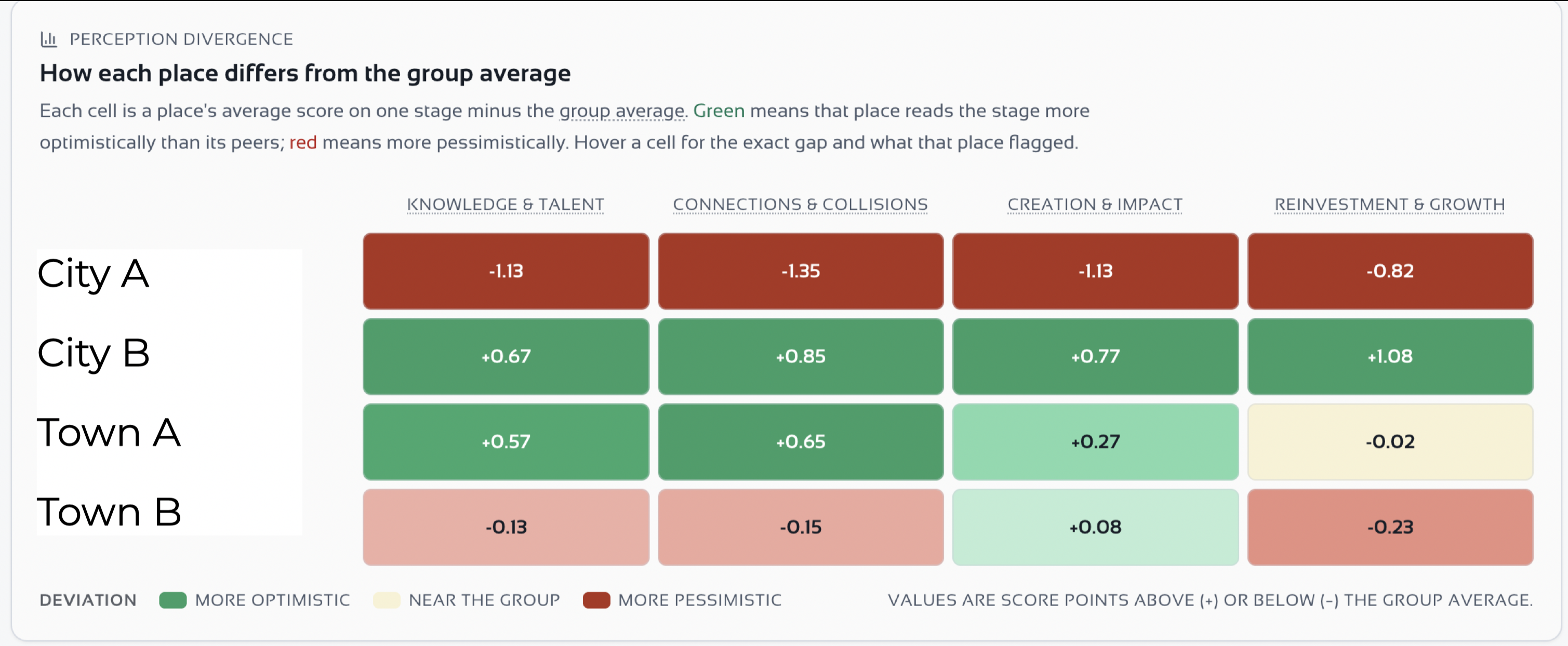
Ratings by question
See exactly which questions divide places or participants, rather than losing the disagreement inside one average.
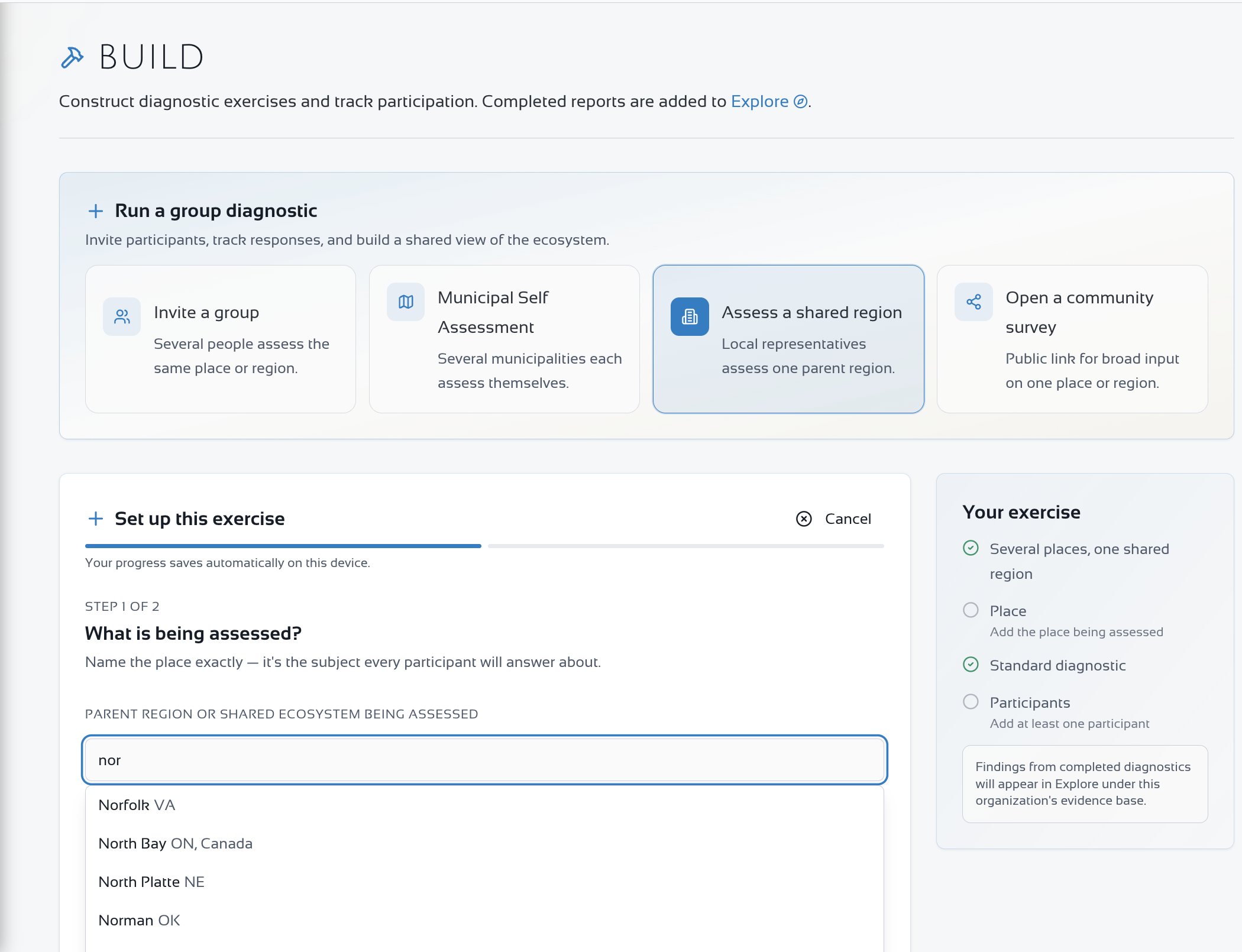
Build
Set up a group diagnostic
Choose the place and who is assessing it, send invite links, and track who has responded. Completed diagnostics are added to Explore for the shared analysis.
Get the complete workspace, USD $499/yearOne annual plan. Unlimited diagnostics, group exercises, Explore, and Deep Dives. Secure checkout through Stripe.
Local questions
Every question tailored to your local ecosystem
Before anyone answers, the diagnostic looks up the universities, agencies, industrial parks, and programs in your region and writes each question around them. Every rating, and every comparison built from them, is about what is actually there.
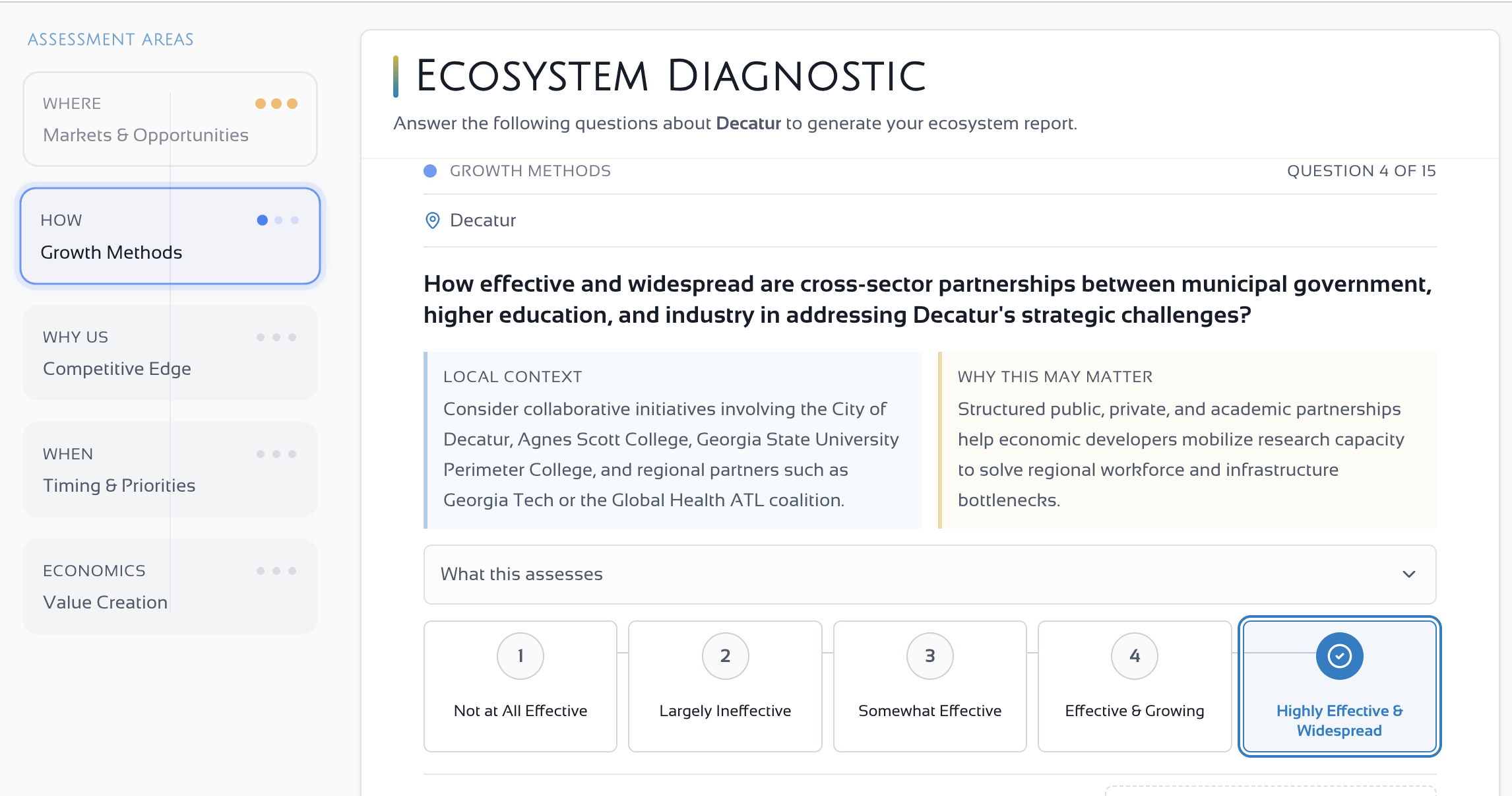
Decatur, Georgia
Names the City of Decatur, Agnes Scott College, Georgia State University Perimeter College, and Georgia Tech.
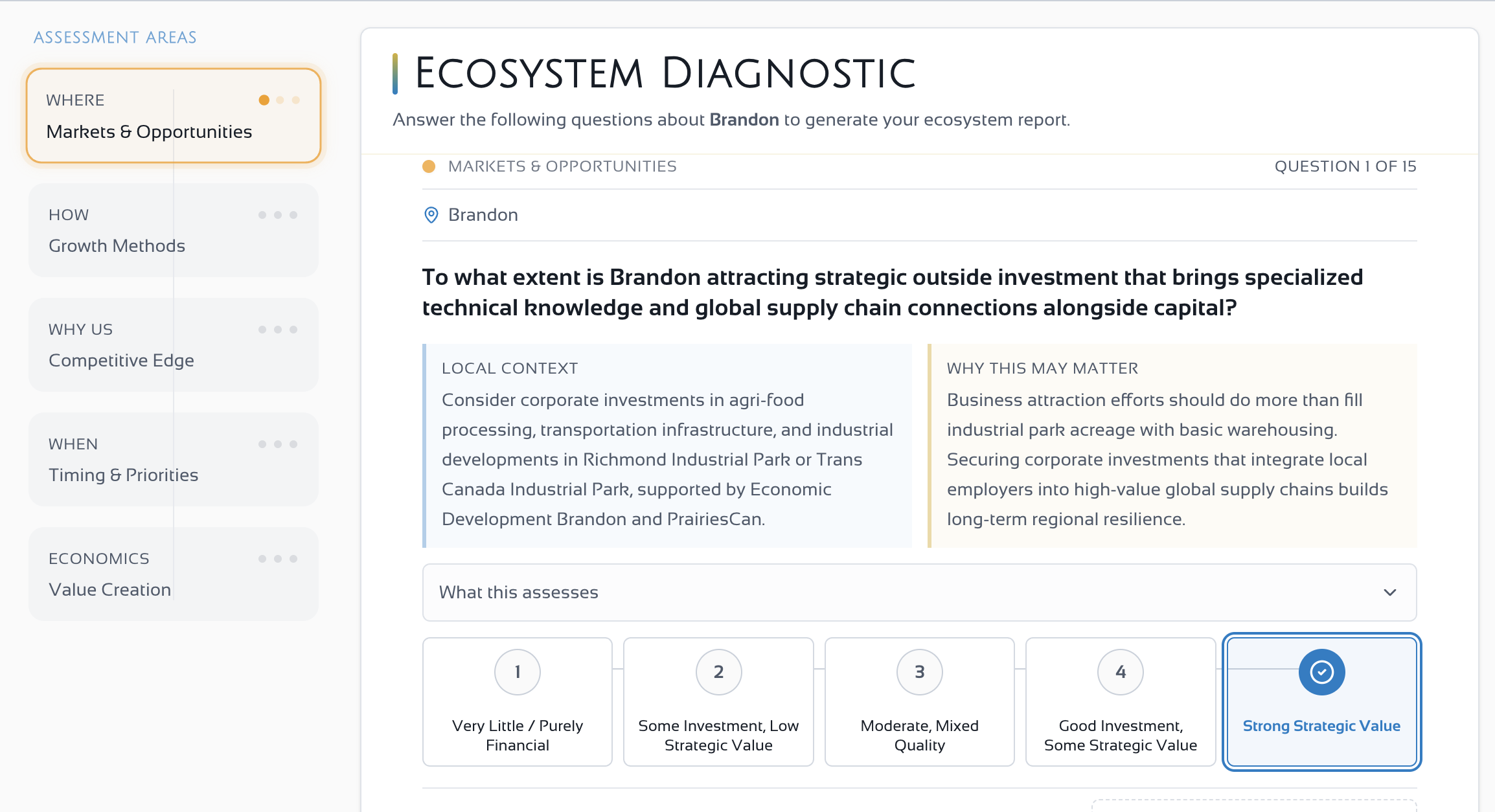
Brandon, Manitoba
Names Richmond Industrial Park, Trans Canada Industrial Park, Economic Development Brandon, and PrairiesCan.
Two places, two different question sets. Your report is built from answers about your own region.
Testimonials
What economic development officers say about The Groundbreakers Ecosystem Navigator
From professionals who have run the diagnostic for their own region.
The platform works. Structured input from economic development professionals across different parts of the county produced clear trends and divergences on growth and innovation. The recommendations were useful and realistic, and the people who answered the questions confirmed the synthesis captured their thinking. That validation is what gives you confidence to take it forward.
“I found the report would be a good way to ground us all, to say, 'Okay, here are some of the objective things that are necessary to move the ecosystem forward'. It would give us a common language and a common way to talk about it ... because the university is obviously going to approach it from an academic perspective, someone from a private sector company, they're going to come at it from a very different perspective. The report, in my mind, could be like a convener... a way of getting everybody on the same page in a discussion document.”
“You get a lot of these reports that come out from various entities and they're so generic that they could have written them about nine-tenths of Western Canada. But the Ecosystem Navigator from the Groundbreakers was clearly very local. There were enough tangible, specific things that I recognize to go, 'Oh yes, this actually knows our region'.”
“I compared it against the 100+ pages we got from a $100,000 regional impact study the provincial government paid for. The Groundbreakers Ecosystem Navigator generated very comparable outputs, found many of the same issues... but yours actually added the additional piece, identifying the need for angel investment to help move the ecosystem forward, which was a clear gap in the original study. From a value-added perspective, yours had more powerful, actionable insights than this third-party report.”
Inside each diagnostic
Each participant receives a full report upon completing the diagnostic
Each participant answers questions written for your place. Their diagnostic identifies the weakest stage of the innovation cycle, scores each stage, maps the local organizations involved, and recommends actions with the people to involve and the research behind them.
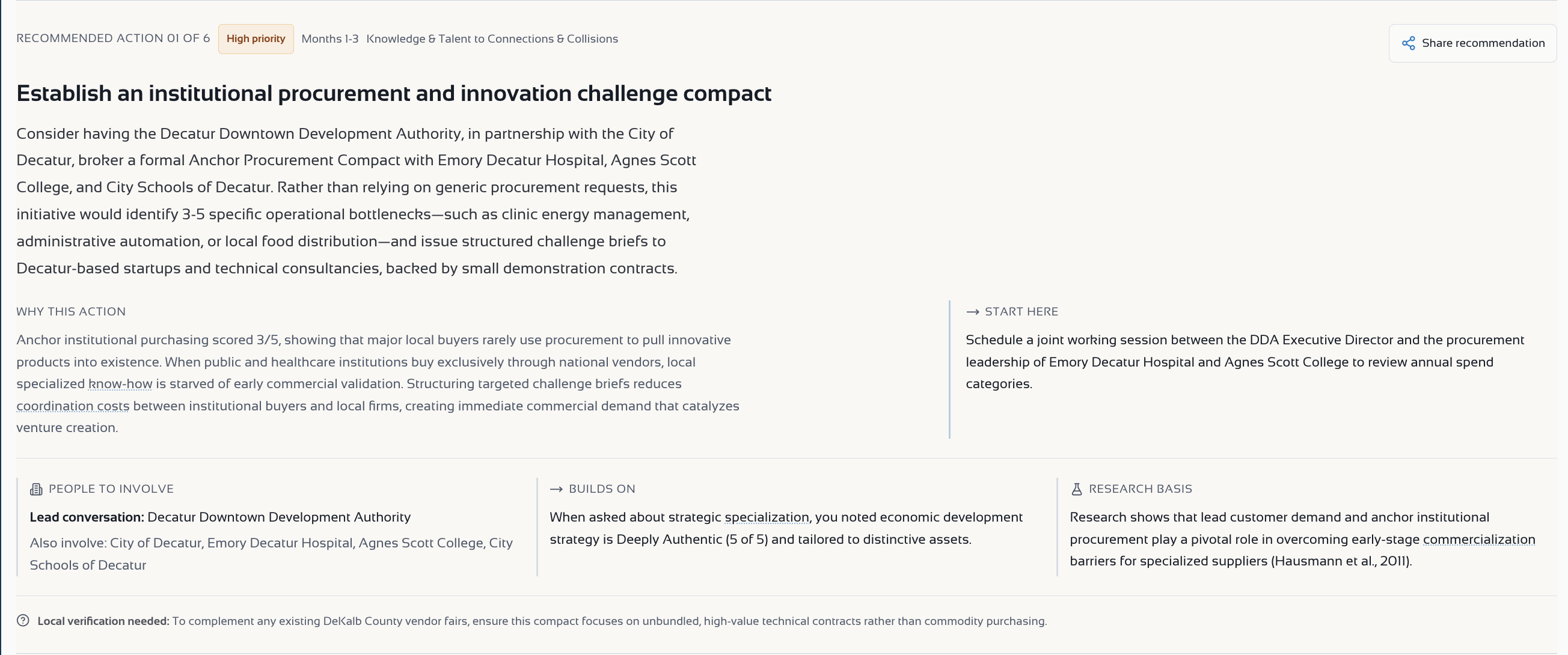
Recommended actions
Decatur, Georgia. Each action names the local organizations to involve, where to start, and the research it draws on.
Pro · USD $499 per workspace per year
One plan with unlimited use
A free account saves two 10-question diagnostics. The paid plan removes the limits on diagnostics, group exercises, and follow-up questions for every place.
Find the weakest stage
15-question diagnostics
More detailed baselines for any place, as often as you need them.
Compare stakeholder ratings
Group exercises
Invite stakeholders or communities and get combined group results.
Ask questions across your evidence
Explore
Analyze reports and places together and compare responses.
Investigate specific issues
Six Deep Dives
Detailed analysis of one strategic area identified in the baseline.
Buying for a county, region, or province? Each additional workspace costs less. A county plus two towns is USD $1,397 a year. See pricing for several communities
Repeated measurement
Measure change over time
Repeat a fixed exercise with the same stakeholder groups. Compare how scores and ratings change, and use the results in the next planning cycle.
Get the complete workspace, USD $499/year“If I do one now, I get a baseline ... I can track the change over time, because then I've got a metric I can show to stakeholders. We can actually measure progress as we build momentum.”
Method
Research basis
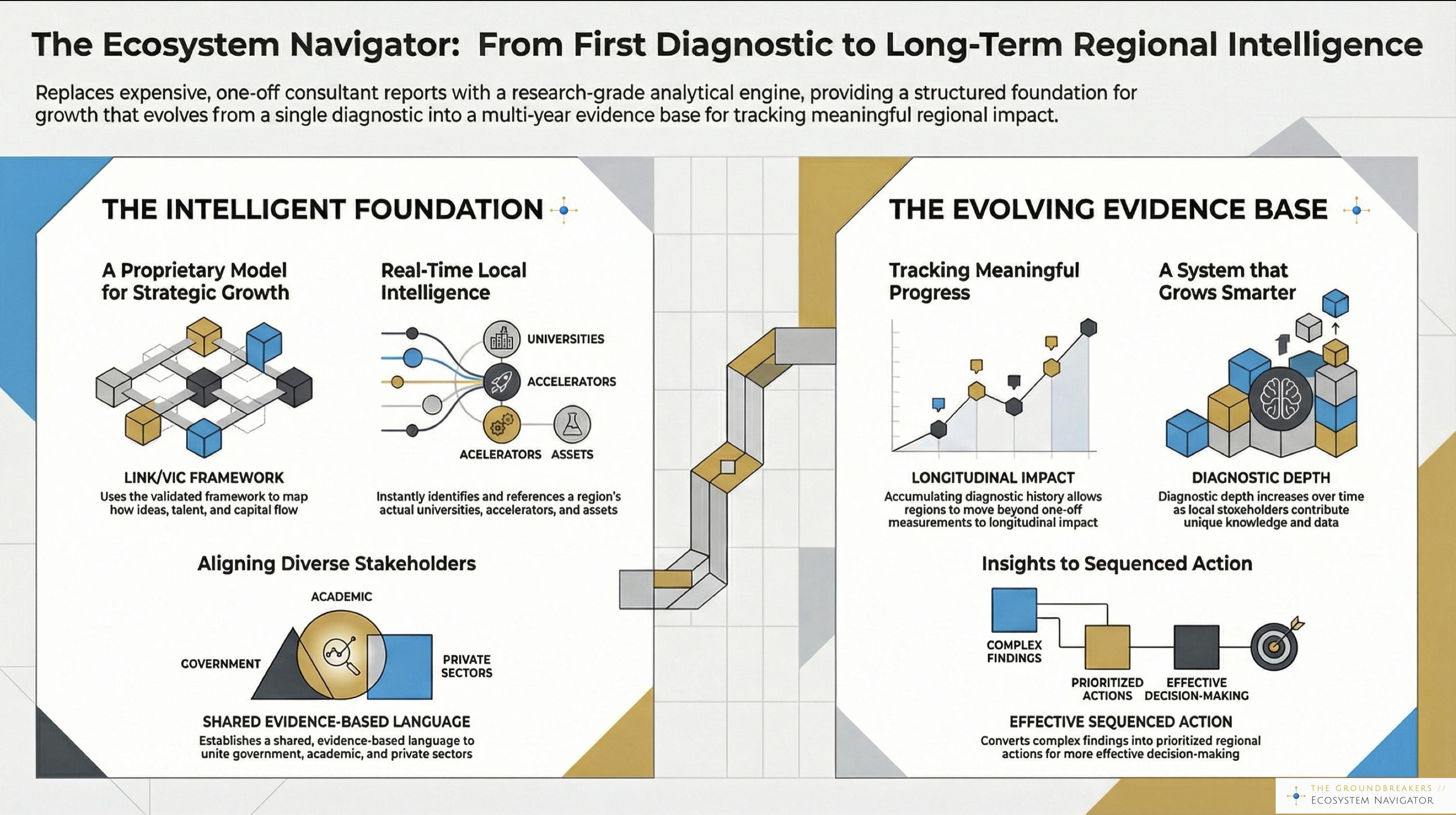
The LINK framework synthesizes corporate strategy theory, economic complexity research from Harvard and MIT, and insights from 50+ interviews with innovation ecosystem leaders.
Structured Expert Elicitation
An established research method for questions where hard data is thin. People with direct knowledge of a place answer the same structured questions, and their answers are compared.
Economic Complexity
Measures how diverse and sophisticated your region's products and services are. It is a predictor of future growth. Pioneered at Harvard and MIT.
50+ Practitioner Interviews
The framework is grounded in conversations with innovation ecosystem CEOs, EDOs, and university leaders across 6 countries.
Questions
Frequently Asked Questions
What does the USD $499 annual platform include?
We serve several communities. Do we pay for each one?
What do I get in the free diagnostic?
Who is this for?
How long does it take?
Can I use this for grant applications?
Start with a free diagnostic
Run a free baseline diagnostic in five minutes. When you need more, the paid workspace adds group exercises, shared evidence, Deep Dives, and repeated measurement.
10 questions · No account needed to start · Save up to 2 reports free
Ready to involve a group or investigate further? Get the complete workspace, USD $499/year and everything it includes.