

Public investment and ecosystem analysis
See where public investment supports regional growth, and where partners see a different picture
Start with a locally tailored analysis from the public-sector perspective. Then invite economic development, universities, investors, and community partners who see the ecosystem from other angles. The Groundbreakers Ecosystem Navigator turns those perspectives into structured evidence for council, budget, and partnership decisions.
Strategic plans set direction. A shared ecosystem analysis shows whether council, staff, economic development, and anchor institutions agree on what is working and what needs attention.
Start with your place
Run your first diagnostic in five minutes
Choose a place and your role. The questions are written around the institutions and conditions in that region.
The free report
What the questions and the report look like
Each question names the institutions in your region. The report gives a key finding, a score for each stage of the innovation cycle, and recommended actions written for government and policy leaders.
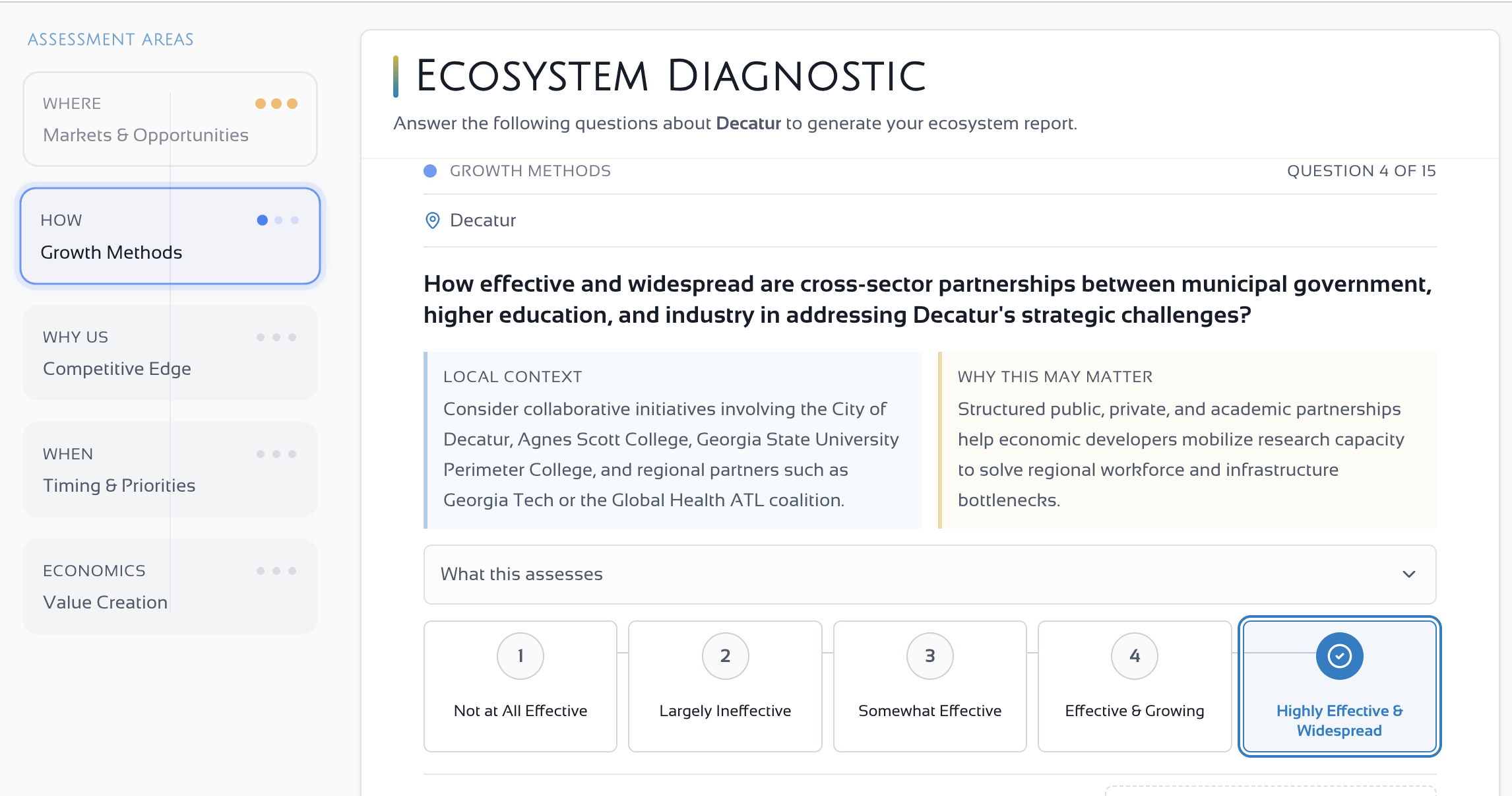
A question, written for one place
Decatur, Georgia. The question names the City of Decatur, Agnes Scott College, Georgia State University Perimeter College, and Georgia Tech.
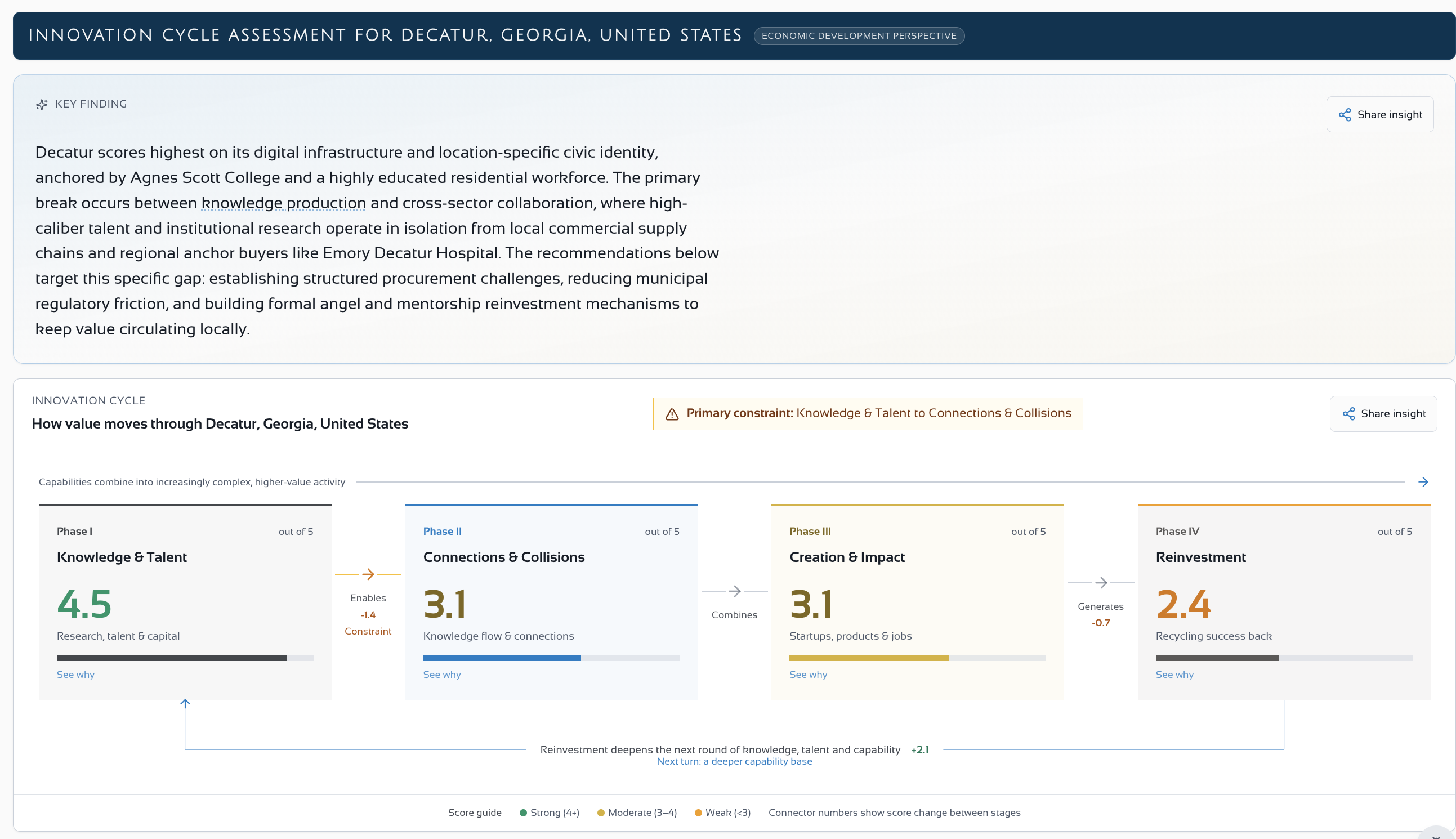
Key finding and cycle scores
The report names the stage where value stops moving and says why.
Common problems in public-sector economic work
Four questions mayors and city managers ask about their own region, and what the diagnostic can tell you about each one.
"How do I justify innovation spending to taxpayers?"
Innovation investment has long payoffs and short election cycles. The diagnostic gives you structured analysis you can take to council, showing how respondents see public investment connecting to outcomes and where more evidence is needed.
"We fund education, then graduates leave."
Graduate retention depends on employers, capital, career paths, and quality of life as well as education. The diagnostic helps test which conditions different partners see as the strongest constraints.
"We approved an innovation district. Now what?"
Rezoning is step one. The diagnostic shows whether the surrounding ecosystem can fill that district: anchor tenants, the talent pipeline, capital access, and transit connections.
"Our strategic plan mentions innovation but doesn't measure it."
The diagnostic scores your region across 35 dimensions and connects each one to the instruments you control: the official plan, procurement, the capital budget, and coordination with other levels of government.
Group diagnostics
Compare how different people rate the same ecosystem
The government and policy view is one part of the picture. Ecosystem Navigator collects it alongside the people who work in the same ecosystem from other roles, then shows the group where they agree, where they differ, and what to look into next.
Diagnose
Run a locally tailored diagnostic from your own role. The free version is 10 questions and takes about five minutes.
Compare
Invite people who work in the ecosystem from other roles, then see where their responses agree and where they differ.
Decide and measure
Investigate the evidence, share clear priorities, and repeat the same exercise to make change visible over time.
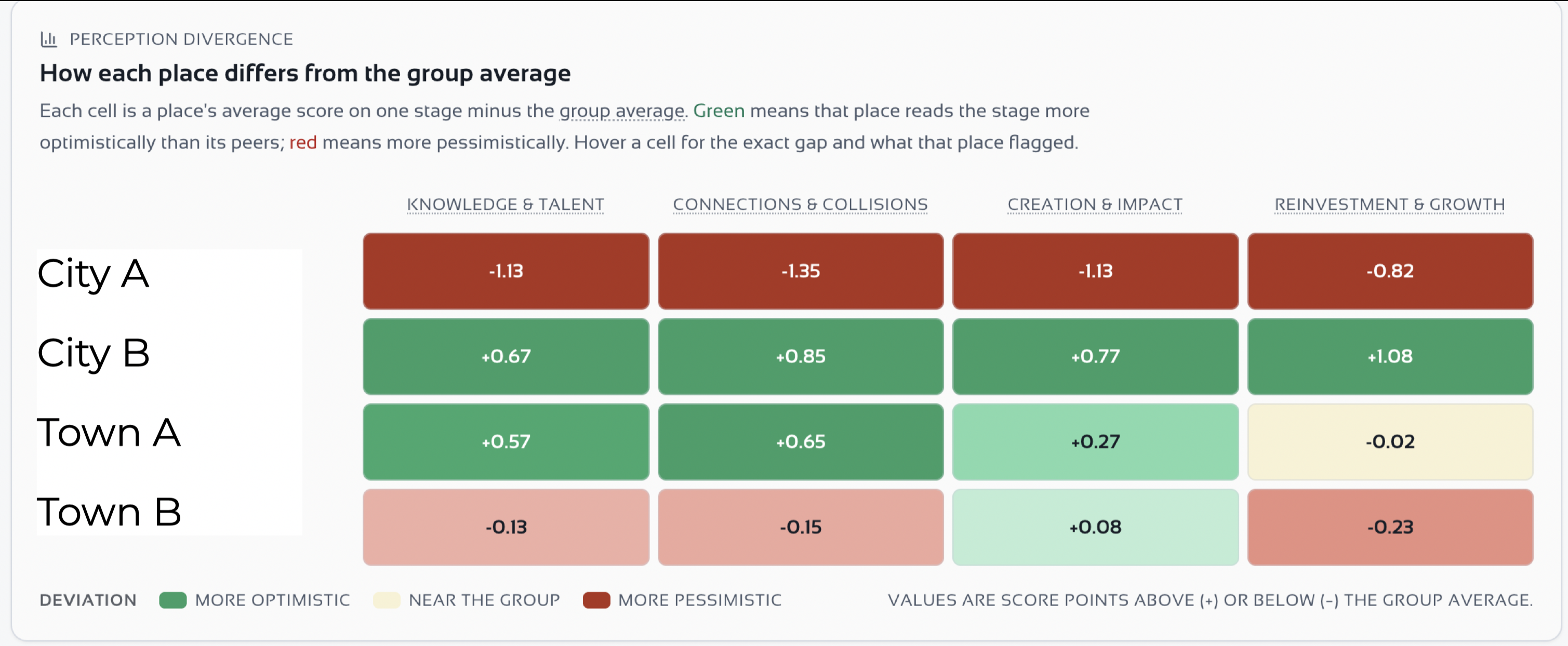
Difference from the group average
Group results in Pro. Each row shows where one place or participant rates higher or lower than the rest of the group.
What the platform gives you
One report can brief council. Multiple perspectives create the evidence base for policy, budget, and partnership decisions.
A scored baseline for your jurisdiction
Scores for how public investment, institutions, talent, and capital connect inside your jurisdiction.
Group diagnostics
Invite departments and partners to answer the same questions so you can see where they agree, where they disagree, and where delivery breaks down.
Evidence base
Each run adds answers, scores, local assets, citations, and recommendations to a record you can revisit during planning cycles.
Reports for council
PDF export, share links, stakeholder briefs, and recommendations written around the instruments you control.
What the report adds to a strategic plan
Strategic plans describe the destination. The diagnostic gathers local views quickly and shows which assumptions need a closer look.
- “Foster a culture of innovation”
- “Attract and retain talent”
- “Support entrepreneurship”
- “Leverage our strengths”
- “Reinvestment & Growth averages 1.8 of 5. Respondents gave local procurement, founder retention, and capital recycling the lowest ratings.”
- “Your zoning decisions created an innovation district, but transit access scores 2.1. The infrastructure does not yet support the vision.”
- “Three workforce programs overlap with no coordination. Recommend inter-departmental alignment...”
Questions from government leaders
I'm a mayor, not an innovation expert. Is this for me?▾
Can I use this in a council presentation?▾
How does this relate to our strategic plan?▾
How is this different from hiring a consultant?▾
What does the free version include?▾
Should our EDO run this too?▾
Run the free diagnostic for your region
Ten questions about your region. A report on whether your policy instruments are reaching the parts of the ecosystem that need them.
10 questions · About 5 minutes · No account required