Investment attraction
Test the regional strengths behind the pitch. Use the economic profile, mapped institutions, talent evidence, and ecosystem gaps to prepare for site-selector and investor conversations.


Economic development research workspace
The Groundbreakers Ecosystem Navigator connects investment attraction, business retention and expansion, entrepreneurship, workforce development, and strategic planning in one evidence base. Gather structured input from government, universities, investors, employers, and community partners, then see the trends and disagreements without losing months to manual analysis.
Field validation in Lethbridge County found the diagnostic closely matched a $100K government study and surfaced an angel investment gap the study missed.
Start with your place
Choose a place and your role. The questions are written around the institutions and conditions in that region.
The free report
Each question names the institutions in your region. The report gives a key finding, a score for each stage of the innovation cycle, and recommended actions written for economic development officers.
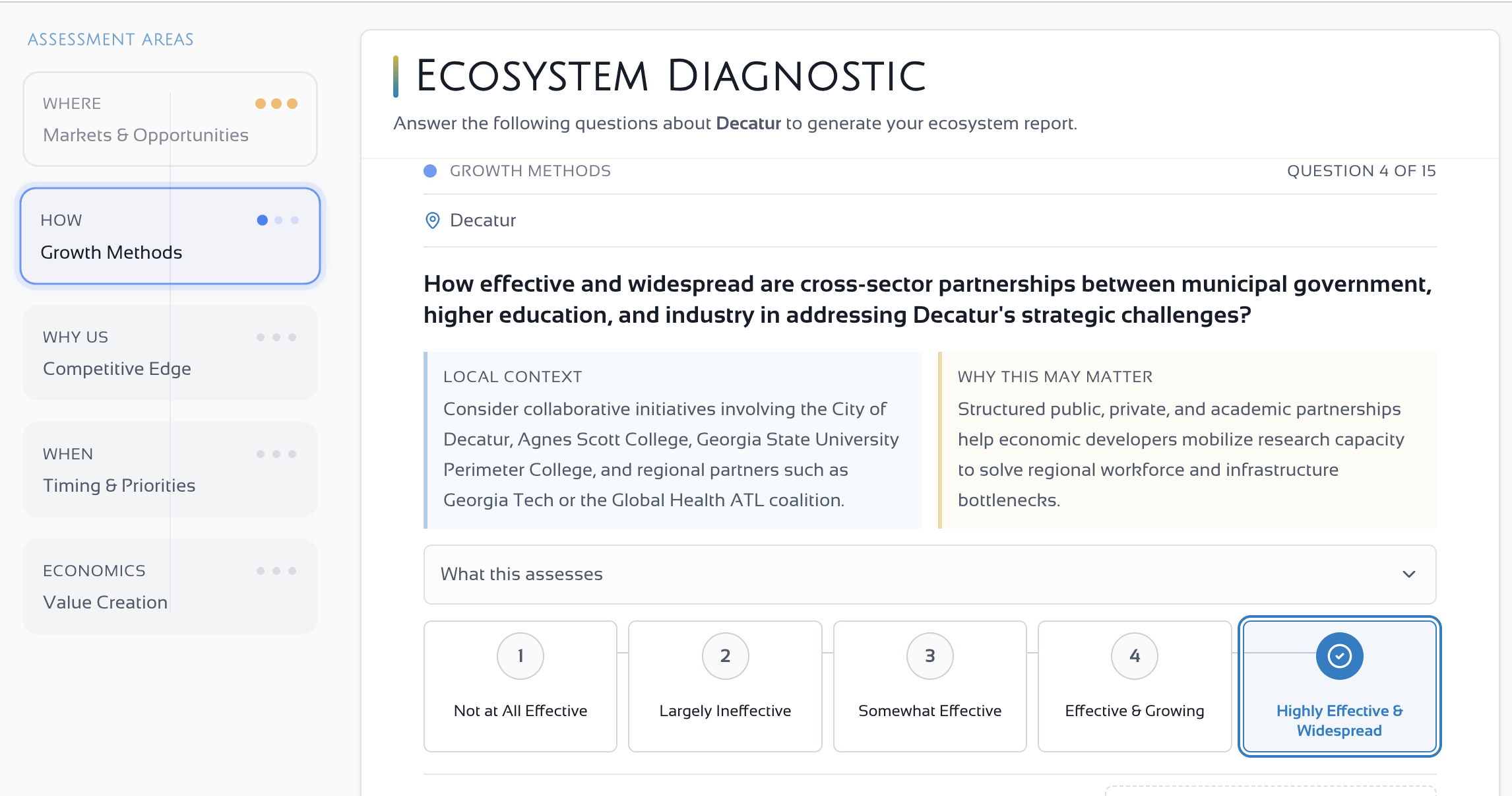
A question, written for one place
Decatur, Georgia. The question names the City of Decatur, Agnes Scott College, Georgia State University Perimeter College, and Georgia Tech.
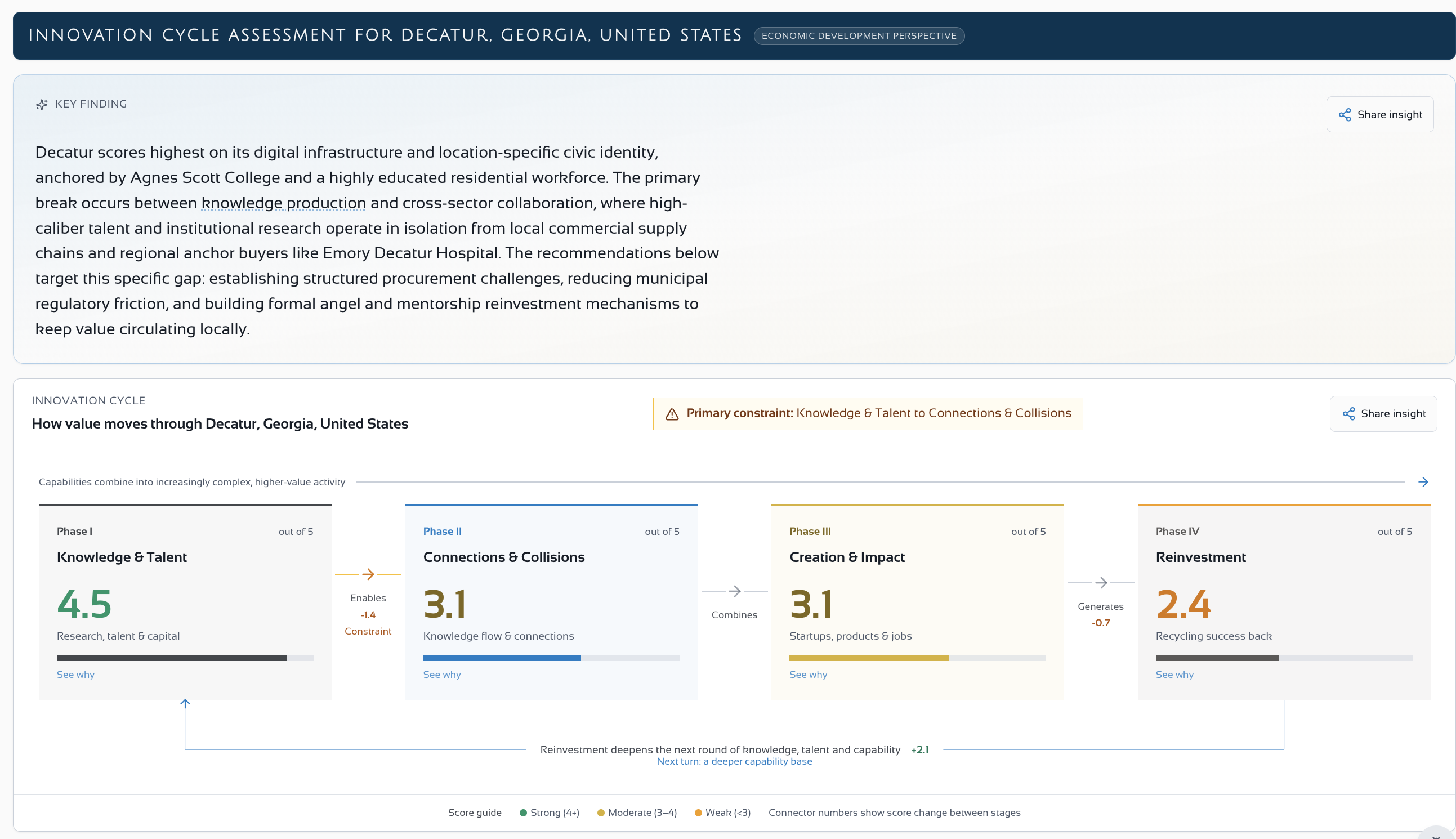
Key finding and cycle scores
The report names the stage where value stops moving and says why.
“Every economic development organization I know is overworked. We don't have time to dig through everything. What we need is a clean, digestible view of the priorities that came out of the expert input, something we can take to partners, council, or our own teams without losing weeks or months to waiting and analysis. That's what this platform is starting to deliver.”
Where it fits in your work
Each function sees one part of the regional economy. Ecosystem Navigator connects them so a prospect brief, a business visit, a startup program, a workforce partnership, and the next strategy update all draw on the same evidence.
Test the regional strengths behind the pitch. Use the economic profile, mapped institutions, talent evidence, and ecosystem gaps to prepare for site-selector and investor conversations.
See whether local firms can reach talent, research, capital, suppliers, and decision-makers. Repeated diagnostics show which conditions are improving and which constraints persist.
Assess the path from ideas to viable companies: commercialization, founder support, mentors, early customers, growth capital, and whether successful ventures reinvest locally.
Connect employer demand with colleges, universities, training programs, attraction efforts, and retention. Identify where the talent pipeline loses people or misses industry needs.
Turn individual perspectives into a shared analysis, investigate the biggest disagreements, set priorities, and repeat the same exercise to measure movement over time.
Four questions EDO directors ask about their own region, and what the diagnostic can tell you about each one.
"We invest in talent, then they leave."
Graduates leave when there is nowhere local to work, raise money, or grow. The diagnostic shows whether your region has the employers, capital, and knowledge base to keep them, or whether you are training people for other regions.
"Our CEDS looks great. Nothing's changed."
Most plans stall because the organizations named in them are not working together. The diagnostic shows which actors are not connected and where your brokering will make the most difference.
"We can't articulate our differentiation to site selectors."
If it is hard to explain why a company should choose your region over the next county, the region has not settled on what it is good at. The diagnostic shows what sets your region apart and what does not.
"The board wants ROI on our incentive spending."
Incentive packages are one tool. The diagnostic scores the whole ecosystem, so you can see whether those investments are building conditions for continued growth or buying one-off wins.
Group diagnostics
The economic development view is one part of the picture. Ecosystem Navigator collects it alongside the people who work in the same ecosystem from other roles, then shows the group where they agree, where they differ, and what to look into next.
Run a locally tailored diagnostic from your own role. The free version is 10 questions and takes about five minutes.
Invite people who work in the ecosystem from other roles, then see where their responses agree and where they differ.
Investigate the evidence, share clear priorities, and repeat the same exercise to make change visible over time.
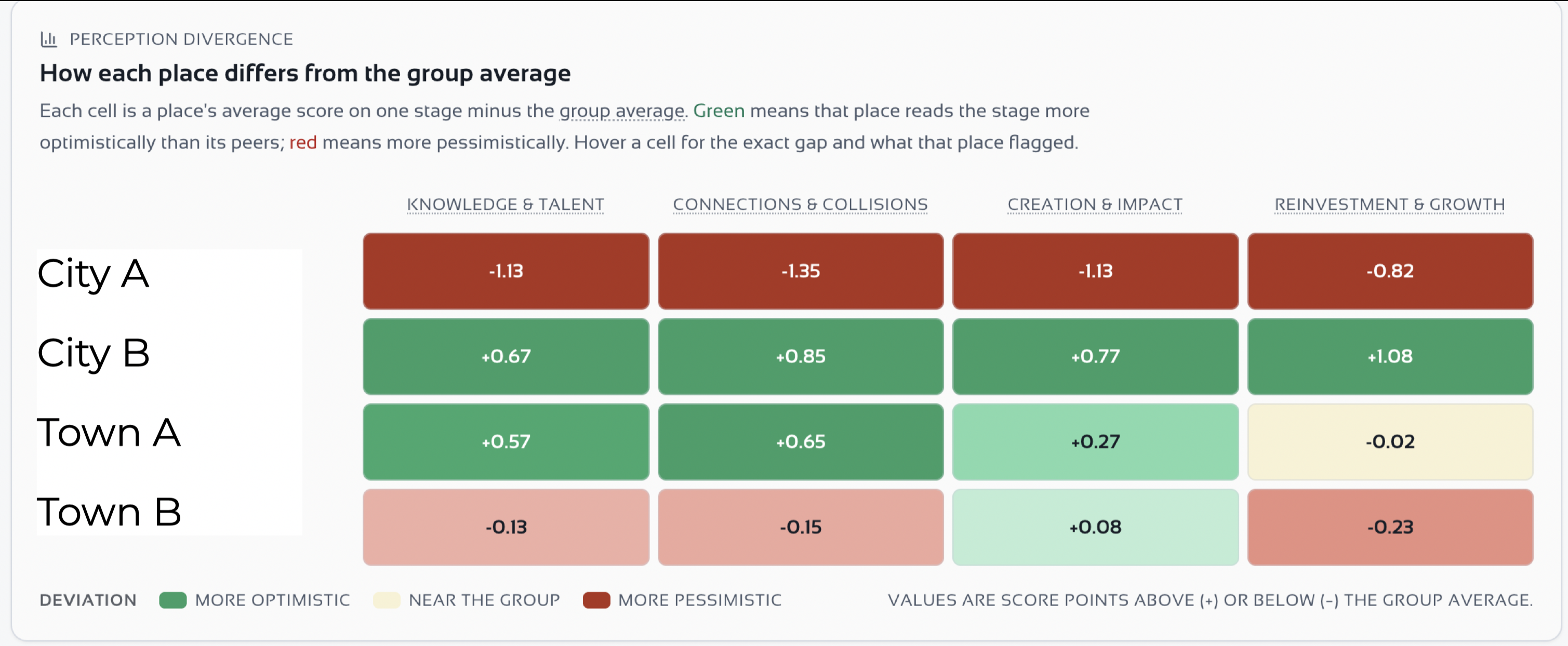
Difference from the group average
Group results in Pro. Each row shows where one place or participant rates higher or lower than the rest of the group.
The first report is useful on its own. The platform becomes more valuable as more perspectives enter the same evidence base.
Scores across 35 dimensions, from questions written around your region's actual institutions, programs, and assets.
Invite other stakeholders to answer the same questions so you can see where they agree, where they differ, and what each role tends to miss.
Each run adds answers, scores, assets, recommendations, and citations to a record of what your ecosystem looks like over time.
Share links, PDF export, stakeholder briefs, and recommendations written around actions your organization can broker.
Annual reports count prospect meetings and jobs announced. The diagnostic tells you whether the ecosystem producing those results is working.
Ten questions about your region. A report on where its innovation ecosystem is working and where it is not.
10 questions · About 5 minutes · No account required