

Regional pipeline and capital analysis
Will this region keep producing investable companies?
Start with a locally tailored analysis of the regional pipeline behind your deal flow. Then compare what founders, economic developers, universities, and capital providers see across the ecosystem. The Groundbreakers Ecosystem Navigator turns those vantage points into shared evidence about talent, commercialization, capital, and reinvestment.
Pitch decks explain the company. A shared ecosystem analysis tests whether the surrounding market has the talent, customers, capital, and reinvestment patterns needed for sustained growth.
Start with your place
Run your first diagnostic in five minutes
Choose a place and your role. The questions are written around the institutions and conditions in that region.
The free report
What the questions and the report look like
Each question names the institutions in your region. The report gives a key finding, a score for each stage of the innovation cycle, and recommended actions written for investors.
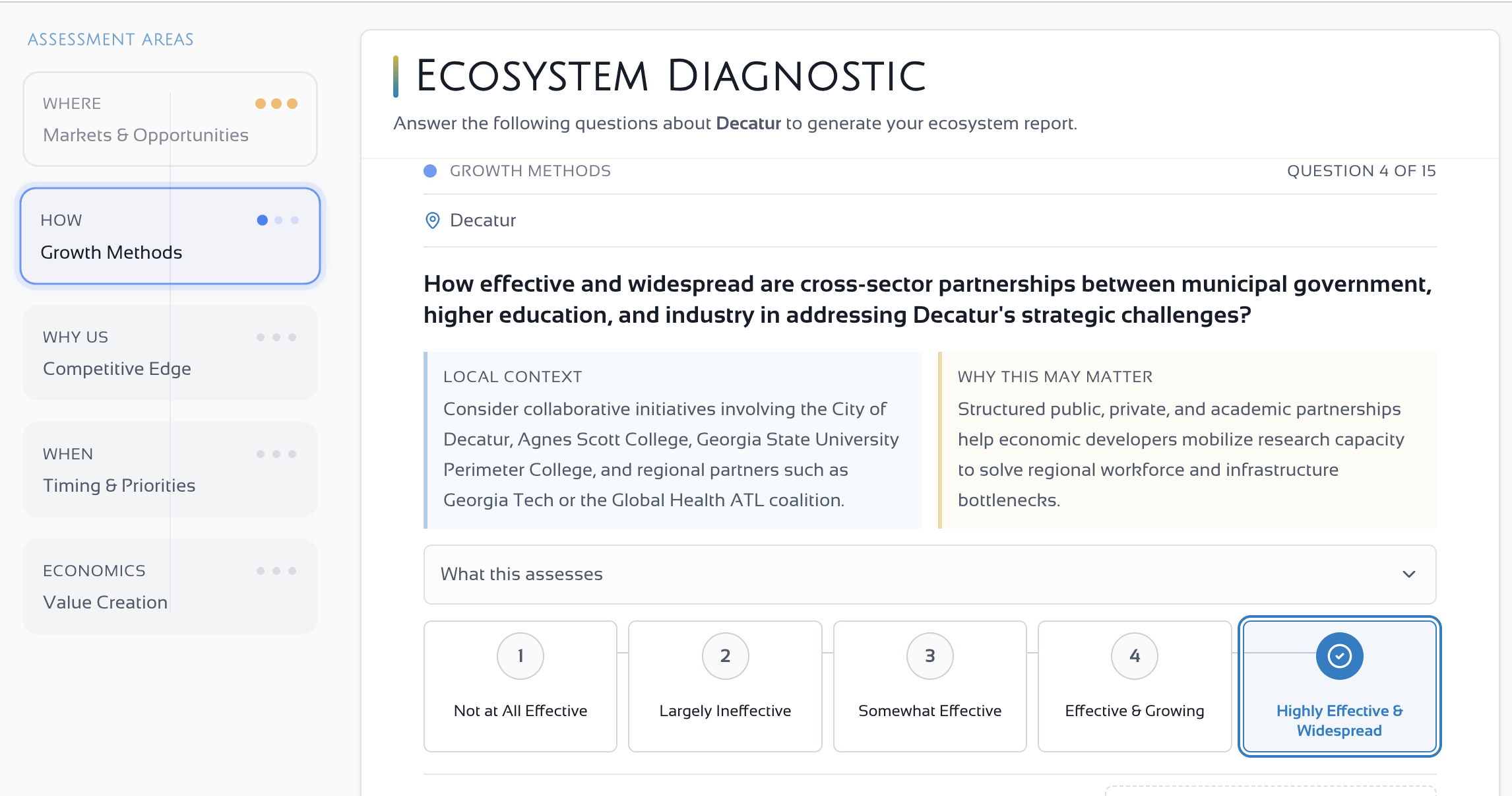
A question, written for one place
Decatur, Georgia. The question names the City of Decatur, Agnes Scott College, Georgia State University Perimeter College, and Georgia Tech.
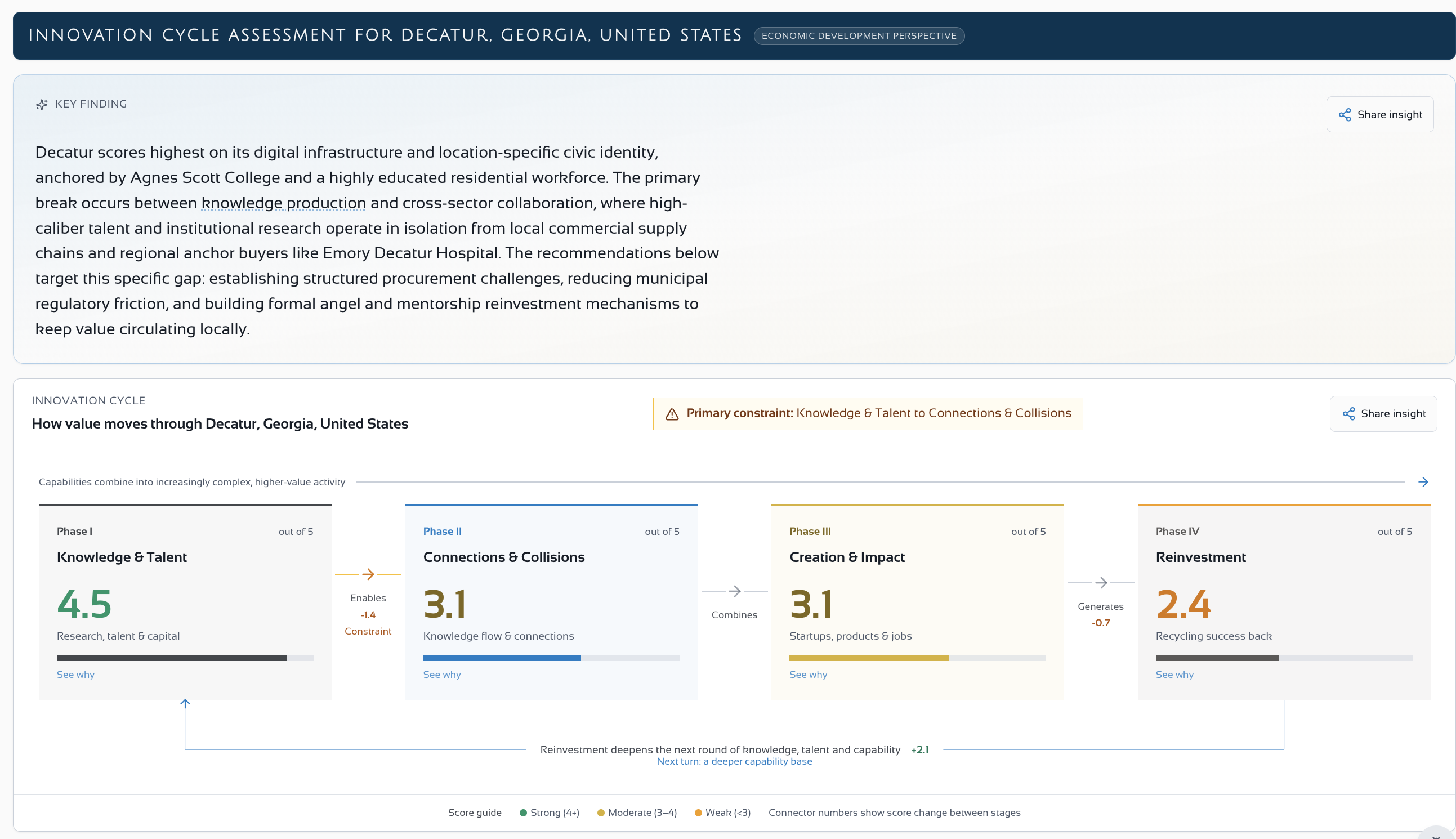
Key finding and cycle scores
The report names the stage where value stops moving and says why.
Common questions about a regional fund thesis
Four questions investors ask about a region before committing capital, and what the diagnostic can tell you about each one.
"Deal flow is thin. I see the same founders recycled."
Thin deal flow is usually a pipeline problem, not a networking problem. The diagnostic looks upstream: are universities producing research that can be commercialized? Are accelerators turning ideas into investable companies? Is the ecosystem feeding your funnel or starving it?
"My best portfolio companies leave to scale."
When founders leave, the ecosystem cannot support growth-stage companies. The diagnostic shows which gap is driving it (talent, follow-on capital, customers, or suppliers) and whether it can be fixed.
"There's no co-investment partner locally."
Syndication depends on how much capital is nearby. The diagnostic maps who else is investing, which stages they cover, and whether the region's capital stack has gaps that limit deal size and follow-on rounds.
"Returns leave the region when companies exit."
If exits keep sending value to larger hubs, local investing stops compounding. The diagnostic scores capital recycling and reinvestment patterns.
Group diagnostics
Compare how different people rate the same ecosystem
The investor and capital market view is one part of the picture. Ecosystem Navigator collects it alongside the people who work in the same ecosystem from other roles, then shows the group where they agree, where they differ, and what to look into next.
Diagnose
Run a locally tailored diagnostic from your own role. The free version is 10 questions and takes about five minutes.
Compare
Invite people who work in the ecosystem from other roles, then see where their responses agree and where they differ.
Decide and measure
Investigate the evidence, share clear priorities, and repeat the same exercise to make change visible over time.
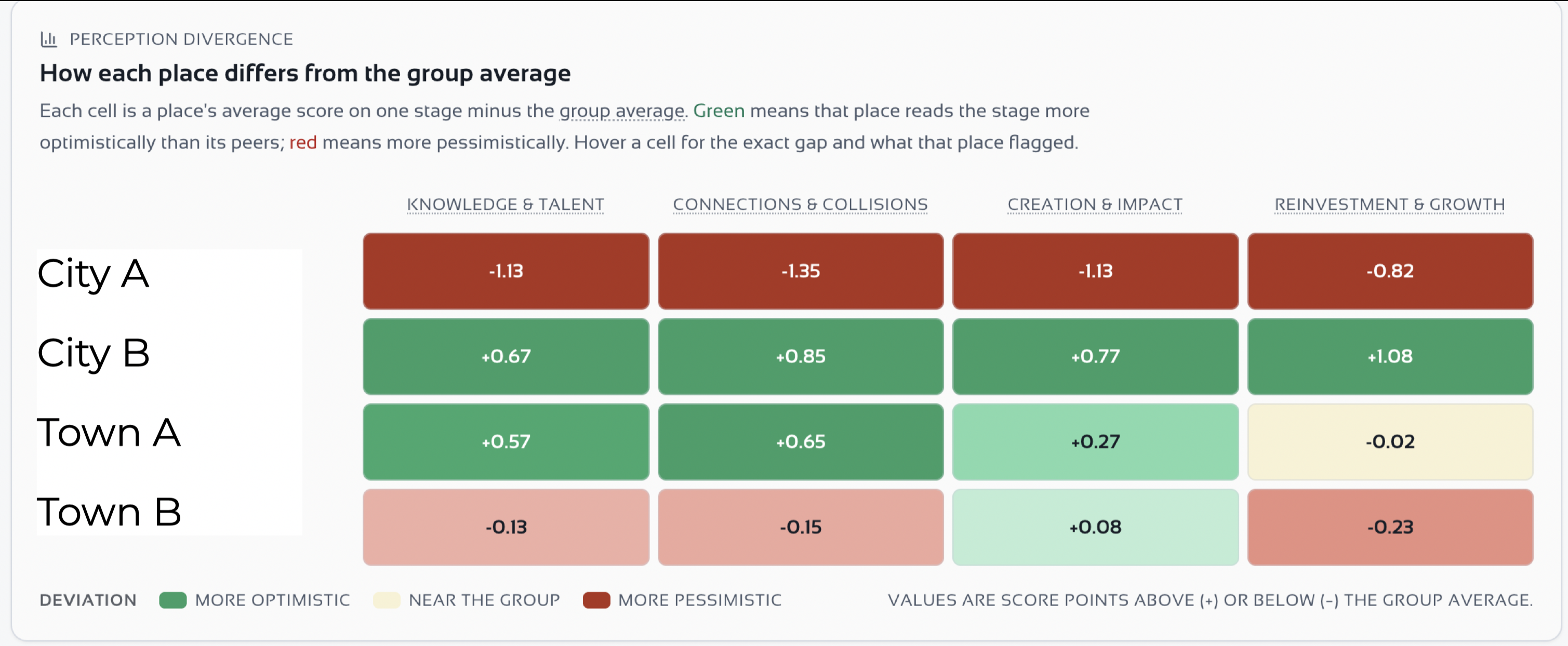
Difference from the group average
Group results in Pro Benchmark. Each row shows where one place or participant rates higher or lower than the rest of the group.
What the platform gives you
The first diagnostic gives a market read. Multiple perspectives build an evidence base for your regional investment thesis.
A scored baseline for the pipeline
Scores for talent depth, commercialization paths, venture creation, capital access, and reinvestment patterns.
Group diagnostics
Compare founders, universities, EDOs, and capital providers on the same questions to find market signals one group is misreading.
Evidence base
Each run adds answers, scores, assets, recommendations, and citations to a record of how the investment environment is changing.
Reports for LPs and co-investors
Shareable reports, PDF export, stakeholder briefs, and market-building priorities for angel networks, co-investment, and founder retention.
What the report says that funding totals do not
Market reports count startups and funding rounds. The diagnostic assesses the ecosystem that produces them.
- Series A deals closed: 12
- Total VC invested: $45M
- Startups founded: 87
- Exits: 3
- “The handoff from knowledge and talent to connections received low ratings. University research rated well, while commercialization paths did not.”
- “Capital recycling scores 1.6. Exits are extracting value, and no local angel network is reinvesting returns.”
- “Two accelerators operate without university pipeline access. Connecting them to the research park would...”
Questions from investors
I invest in companies, not ecosystems. Why should I care?▾
How does this help my investment thesis?▾
Can I share this with LPs or co-investors?▾
Can regional partners run it too?▾
How is this different from PitchBook or Crunchbase data?▾
What does the free version include?▾
Run the free diagnostic for a region you invest in
Ten questions about the region. A report on whether its ecosystem can keep producing investable companies.
10 questions · About 5 minutes · No account required